WHEN TO GO · A PAGE ABOUT ODDS, NOT SEASONS
Best time to see the snow monkeys — two lotteries in one day, and they fall in opposite months
The park says the monkeys bathe to get through a winter that falls below −10 °C, so the bath works best when standing outside is worst. That's lottery one. Since 6 August 2026 the park sells a dated ticket, and the days everyone wants are the same cold days — that's lottery two. January wins the first and loses the second; June the reverse. Everything below follows from that.

They get in to escape the cold — so the bath works when standing outside is worst. The park adds: not every hour, not all year, and some days not at all.
DAY
A daily limit is a fixed number; demand isn't. The squeeze lands on exactly the months the pool is best — our reading of the mechanism, not a park statistic.
QUICK ANSWERS — THE PAGE IN SIX LINES
- When is the best time to see the snow monkeys bathing?
- December to February: in January the mean air temperature in Nagano city is −0.4 °C with 63 cm of snowfall (JMA normals 1991–2020), and the park says the monkeys bathe to get through cold below −10 °C, so the bath is used most.
- Do the monkeys come every day?
- No — the park says they may not appear at all on some days, and in autumn (October–November mating season) their appearance is «particularly sporadic».
- When are the babies born?
- April to June, peaking in May; the first infants are usually visible in April, when cherry blossom also reaches Nagano mid-month.
- Is there a best hour of the day?
- None is published: the park posts a same-day forecast of when the troop comes down and live cameras, not a feeding time — check both on the morning you go.
- Do I need a ticket in advance?
- Since 6 August 2026 the park sells a dated online ticket (¥800 (≈$5.1) per adult) and can delay or refuse walk-ups on crowded days; a tour with the ticket included settles it in one purchase.
- When does the snow arrive?
- First flakes mid-to-late November, snow settles from mid-December, and the most reliable cover is late December to late February.
Climate: JMA normals 1991–2020 for Nagano city, 418 m; the park sits at 850 m and runs 2–3 °C colder. Tour prices: snapshot 7 September 2026, converted at ¥156 = $1. Park facts checked 2 September 2026.
Two lotteries in one day — the pool and the gate
Twelve months across, two lanes. The upper lane is how likely the monkeys are in the water — driven by cold, cut by the mating season. The lower lane is how tight the dated ticket is — driven by demand for the same months. Read them together and they mirror. Every month is a link to its own page.
The month the bath is used most is the month the dated ticket decides whether you get in at all.
Nobody needs a hot bath in 20 °C air; nobody is queuing for a ticket either.
The honest «but»: the gate lane is our reading of a mechanism — a fixed daily limit meeting seasonal demand — not a statistic the park has published. The pool lane rests on what the park does say: the monkeys bathe to escape winter cold, don't use the bath every hour or all year, and in autumn may not come at all. Where we're reading, the ribbon is hatched; where the park is speaking, it's solid.
Book with the ticket included, $140 (≈¥21,800)The twelve months in one table
JMA NORMALS 1991–2020 · NAGANO CITYMean air temperature and monthly snowfall for Nagano city, the site's six verdict seals, and what else the month carries. Each month links to its own page for the longer version.
BEST ODDS the bath in use mostGOOD / BABIES a reason, but not the bathQUIET little of eitherRISKY the park says they may not come
| MONTH | MEAN AIR°C · NAGANO CITY | SNOWFALLCM PER MONTH | VERDICT | WHAT ELSE IS IN THE MONTH |
|---|---|---|---|---|
| January | −0.4 °C | 63 cm | BEST ODDS — the bath is used most | The deepest cold of the year |
| February | 0.4 °C | 50 cm | BEST ODDS — the bath is used most | The deepest snow cover |
| March | 4.3 °C | 17 cm | GOOD — still cold enough, snow thinning | Snow thins towards the end of the month |
| April | 10.6 °C | 2 cm | BABIES — first infants of the year | First infants · cherry blossom mid-month |
| May | 16.4 °C | 0 cm | BABIES — peak of births | Peak births · Golden Week 29 Apr–5 May |
| June | 20.4 °C | 0 cm | QUIET — little bathing, few visitors | Rainy season |
| July | 24.3 °C | 0 cm | QUIET — little bathing, few visitors | Wardens bait the pool to get them in at all |
| August | 25.4 °C | 0 cm | QUIET — little bathing, few visitors | The same |
| September | 21.0 °C | 0 cm | QUIET — little bathing, few visitors | Food still plentiful in the mountains |
| October | 14.4 °C | 0 cm | RISKY — the park says the monkeys may not appear at all | Mating season begins · least predictable |
| November | 7.9 °C | 1 cm | RISKY — the park says the monkeys may not appear at all | Mating season · Ebisu-kō fireworks 23 November |
| December | 2.3 °C | 30 cm | BEST ODDS — the bath is used most | Mating season ends · snow settles from mid-month |
Figures are JMA normals 1991–2020 for Nagano city at 418 m; the park stands at 850 m and runs 2–3 °C colder · «snowfall» is what falls in the month, not the depth lying on the ground — the two are different quantities · verdict seals are the site's six labels, shared with the home page · the one tour that runs in every row of this table, with live dates →
Do the monkeys come every day?
No. Here is what the park itself says, without softening — and the one tool that actually works.
They may not show up at all
Staff draw the troop down during opening hours for viewing, but the park states plainly that on certain days the monkeys may not appear — and that in autumn their appearance is «PARTICULARLY SPORADIC».
They don't bathe every hour or all year
The bath is for escaping winter cold. The park says the monkeys do not use it at all hours of the day, nor throughout the year. A winter visit is a bath probability, not a bath guarantee.
The forecast and the cameras are the only tool
The park publishes a same-day forecast of when the troop comes down and asks you to check before setting out and again on the day — via its live cameras and social channels. No feeding time is published. NOTHING ELSE HERE IS A MEASUREMENT.
Come 30 minutes before closing at the latest
The park's own request. Hours are 8:30–17:00 April–October and 9:00–16:00 November–March, open every day except weather closures — and the trail eats 25–40 minutes of that each way.
Why they get in at all — about 160 wild macaques
- They are wild and free to leave. Roughly 160 Japanese macaques live in the valley; nothing fences them in.
- Bathing is thermoregulation. They get into the hot water to escape the cold; monkeys that bathe have been measured with lower stress-hormone levels.
- Autumn keeps them uphill. Food is still plentiful in the mountains from October, and the mating season (October–December) pulls attention elsewhere — so they come down less.
- Summer swims are different. In July–August (24–25 °C) they get in to cool off, not to warm up — a swim, not a soak.
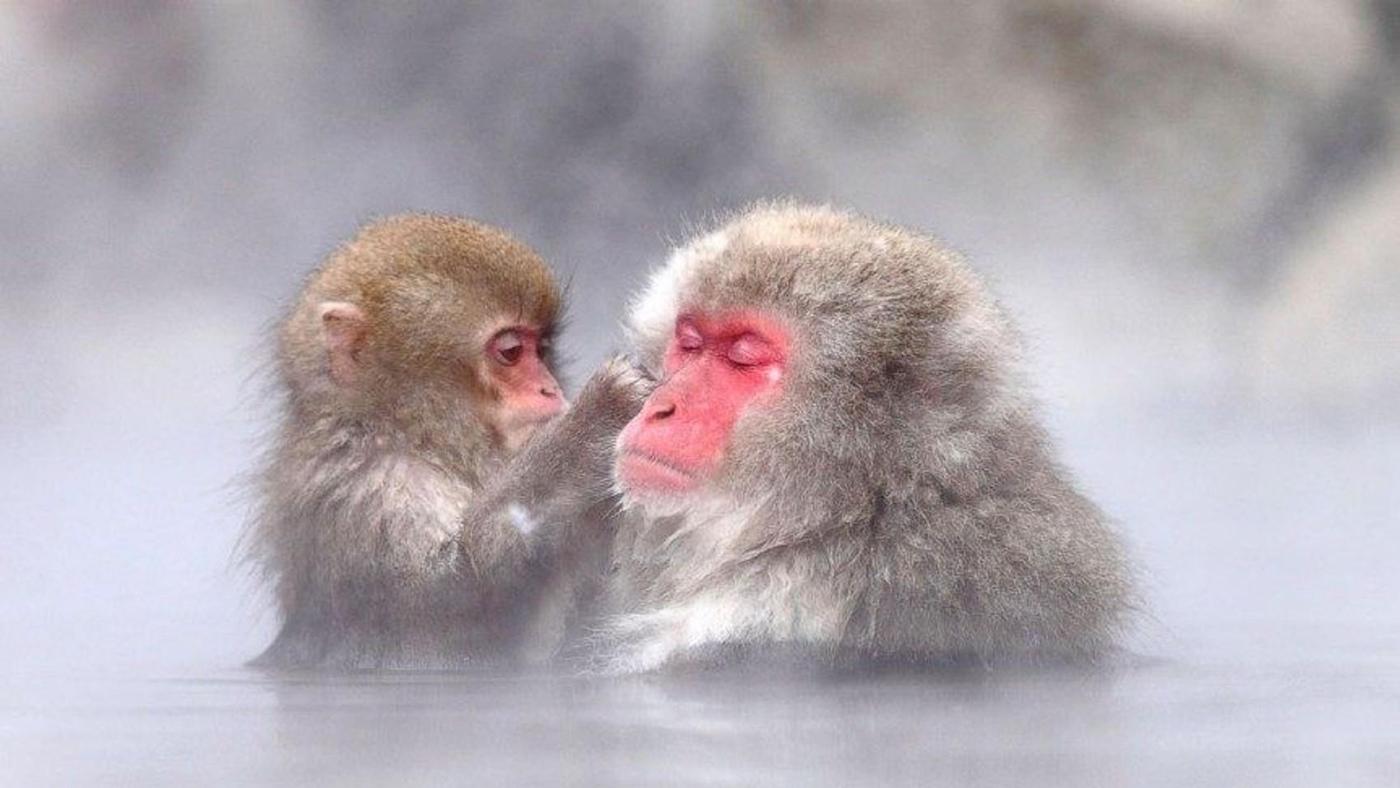
No tour can improve these odds
The park feeds the troop and posts a forecast each morning. A guide reads the same forecast you can, and the private car waits in the same valley for the same monkeys. Two things do help, and only two: look at the camera before you set out, and go in a month when the bath is busiest.
The third one is a tour. It is here because that day also has Zenkō-ji and a sake tasting in it — so an empty pool costs you the monkeys, not the whole day.
What's the best hour of the day?
There isn't a published one. The park posts a same-day forecast and live cameras, not a golden hour — any page that names one made it up. What can be shown is the shape of the day: how little of the opening hours is really yours once the walk and the closing rule are subtracted.
Seven hours on paper; roughly five and a half at the pool at the very most, and only if you're on the trail at nine. What decides your day is not morning versus afternoon but the hour you step onto the path — and whether the forecast says the troop is down.
More hours, less bathing: the summer window is wider by ninety minutes, but in 20–25 °C air the pool is mostly empty. The trail is the same 1.6–2 km in every month — no strollers, wheelchairs or suitcases, in July as in January.
No tour gets you there for opening
Every guided day starts from a station and gets to the valley mid-morning. The first hour is what sleeping nearby buys you, and nothing else buys it. Both links below help with that, and neither earns this site anything.
When does the snow really arrive?
Monthly snowfall for Nagano city, the same JMA normals as the table. The gorge itself runs colder and deeper — up to −10 °C and more than a meter of snow by the park's own record.
Snowfall in cm per month is the amount that falls; snow cover (depth on the ground) is a different measurement and is not shown here · the deep-snow months are also the crowded ones — live dates for the day trip →
What if your dates are October or November?
Not «don't go» — but go knowing the pool lane is broken, not thin. The park's own word for autumn is «sporadic»: some days the troop simply stays in the mountains, and nobody refunds a no-show.
Check the forecast and the cameras that morning
The park's same-day forecast of when the troop comes down is the only instrument there is. If it says «not yet», the valley is still a beautiful walk — but plan the day around that possibility, not against it.
Buy a day that has something besides monkeys
Zenkō-ji, Shibu Onsen's nine baths, Obuse, a sake tasting: in autumn the monkeys should be the bonus, not the point. The year-round $140 (≈¥21,800) Nagano day trip carries Zenkō-ji and sake either way.
The one date autumn has to itself — 23 November
The Ebisu-kō fireworks tour runs on that single day: $217 (≈¥33,900) per person, park ticket included, rated 4.1 from only 10 reviews — the lowest on this page. It's here because it's a date, not because it's a recommendation.
Nagano: Snow Monkeys, Zenkoji Temple & Sake Day Trip
4.9965 reviews
8–12 h · park ticket included · the day has a temple and a tasting even if the troop stays up.
November 23: Ebisu-ko Fireworks & Snow Monkey Tour
4.110 reviewsONLY 10 — READ IT AS A DATE, NOT A RATING
Park ticket included · the fireworks are the certain half of the day; the monkeys are the uncertain half.
The ticket, month by month — what changed on 6 August 2026
The park now sells a dated online ticket. There are no time slots — the date is the whole booking. The gate still sells tickets, but on crowded days entry can be delayed or refused.
The facts, and how firm each one is
- Dated online ticket since 6 August 2026 — ¥800 (≈$5) per adult, ¥400 (≈$2.5) for ages 6–17, free up to age 5. PARK, FIRM
- Walk-ups still possible — the on-site counter works, but on busy days entry may be delayed or refused. PARK, FIRM
- A daily cap of about 2,000 — reported by media citing the park in June 2026; the park itself has not published the number. PRESS, JUNE 2026 · TREAT AS UNCONFIRMED
- Which months squeeze — December–February, when the bath is best, plus Golden Week (29 April–5 May). Our reading of fixed cap × seasonal demand, not a park statistic. OUR READING
One purchase closes the question
Every tour on this page includes the park ticket, so the dated-entry question is the operator's, not yours. For a January date, that is the single most useful thing a tour buys.
LIVE DATES · $140 (≈¥21,800) · RUNS ALL YEAR · TICKET INCLUDED · 965 REVIEWS
LIVE DATES · $151 (≈¥23,600) · TOKYO AND BACK IN A DAY · TICKET AND LUNCH IN
Best month — for what, exactly?
«Best» depends on what you came for. Six goals, one month each, one sentence why, and the tour that fits.
The deepest cold and the deepest cover: −0.4 °C and 0.4 °C mean air, the bath in use most — and the tightest gate, so book the ticket into the tour.
Births run April–June and peak in May; the first infants show in April. The pool is mostly idle by then — you're coming for the troop, not the bath.
Cherry blossom reaches Nagano mid-month, the same weeks the first infants appear — the only month with both.
The open gate of the year — and an empty bath. Take the short tour and make the day about Shibu Onsen's own baths.
$128 (≈¥20,000) per person with the park ticket, soba lunch and a Shibu public bath — the lowest price on this page, with only 9 reviews so far.
When the dated ticket matters most, the Shinjuku coach carries it and lunch in one price — the only group tour that leaves Tokyo.
LIVE DATES · $140 (≈¥21,800) · APRIL ONLY · MONKEYS AND BLOSSOM IN ONE DAY
THE WORDS ON THIS PAGE, DEFINED ONCE
- MATING SEASON
- October to December, when the troop's attention and food are both up the mountain and visits to the pool become, in the park's word, sporadic.
- DATED TICKET
- The park's online entry ticket for one specific date, sold since 6 August 2026 — no time slots; ¥800 (≈$5) per adult.
- SNOWFALL VS SNOW COVER
- Snowfall is how much falls in a month (the cm figures here); snow cover is how deep it lies on the ground on a given day — a different measurement.
- THE DESCENT FORECAST
- The park's same-day published estimate of when the troop will come down to the pool, to be checked before departure and again on the day, alongside the live cameras.
Is January really the best month? And 9 more honest answers
What is the best month to see the snow monkeys bathing?
January, then February and December: in January the mean air temperature in Nagano city is −0.4 °C with 63 cm of snowfall (JMA normals 1991–2020), and the park says the monkeys bathe to get through cold below −10 °C, so the bath is used most. The park sits 2–3 °C colder still. It is also the month the dated ticket bites hardest — book it into a tour.
Do the monkeys come to the pool every day?
No. The park says they may not appear at all on certain days, and that in autumn their appearance is particularly sporadic. Roughly 160 wild macaques live in the valley and are free to stay uphill; the same-day descent forecast and live cameras are the only way to know.
Is there a best time of day?
No published one. The park posts a forecast of when the troop comes down and asks visitors to check it on the day; it publishes no feeding hour. What matters is stepping onto the trail early enough: winter hours are 9:00–16:00, the walk is 25–40 minutes each way, and the park asks you to arrive 30 minutes before closing.
When are the baby monkeys born?
April to June, peaking in May. The first infants are usually visible in April, when cherry blossom also reaches Nagano mid-month — the $140 (≈¥21,800) Cherry Blossom tour runs in April only for that reason.
When does the snow arrive at the park?
First flakes fall mid-to-late November, snow settles from mid-December, and the most reliable cover is late December to late February. In the gorge itself the park records up to −10 °C and more than a meter of snow.
Is October or November a bad time?
It is the least predictable: October–December is mating season, food is still plentiful uphill, and the park itself calls autumn appearances sporadic. If those are your dates, check the forecast that morning and choose a day with a temple or an onsen in it — the $140 (≈¥21,800) Nagano day trip, or the 23 November fireworks tour ($217, 4.1 from 10 reviews).
Do I need to buy the park ticket in advance?
Since 6 August 2026 the park sells a dated online ticket at ¥800 (≈$5) per adult and can delay or refuse walk-ups on crowded days. Media reported a cap of about 2,000 visitors a day in June 2026, though the park has not published that figure. Every tour on this page includes the ticket.
Do the monkeys bathe in summer?
Rarely. At 24.3 and 25.4 °C mean air there is nothing to warm up against, and the park says the monkeys bathe to stave off the cold — not throughout the year. Wardens sometimes throw food into the water to bring them in at all, and when monkeys do get in it is mostly the young, playing. The steaming-pool photograph depends on cold air, which is why it belongs to December–February.
What are the opening hours by season?
8:30–17:00 from April to October and 9:00–16:00 from November to March, every day except weather closures. Subtract 25–40 minutes of trail each way and the park's 30-minute-before-closing request to get your real window.
Which tour fits which month?
December–February: the $140 (≈¥21,800) Nagano day trip (4.9 from 965 reviews) or the $151 Tokyo coach, both with the ticket included. April: the $140 (≈¥21,800) Cherry Blossom tour. Any month for the cheapest guided day: the $128 (≈¥20,000) Soba & Shibu Onsen tour, 4 hours, 9 reviews so far. 23 November only: the $217 (≈¥33,900) fireworks tour.
Every month above runs, and the monkeys are never promised in any of them · the tour that runs in all twelve, with live dates →
Pick the lottery you'd rather lose — then buy the ticket that covers the other
Cold months for the bath, warm months for the gate. Whichever you choose, a tour with the park ticket in it takes one of the two dice out of your hands.
Book the $140 (≈¥21,800) tour, ticket includedHOW TO GET THERE, PRICED · THE PARK — HOURS AND RULES · ALL 21 TOURS